
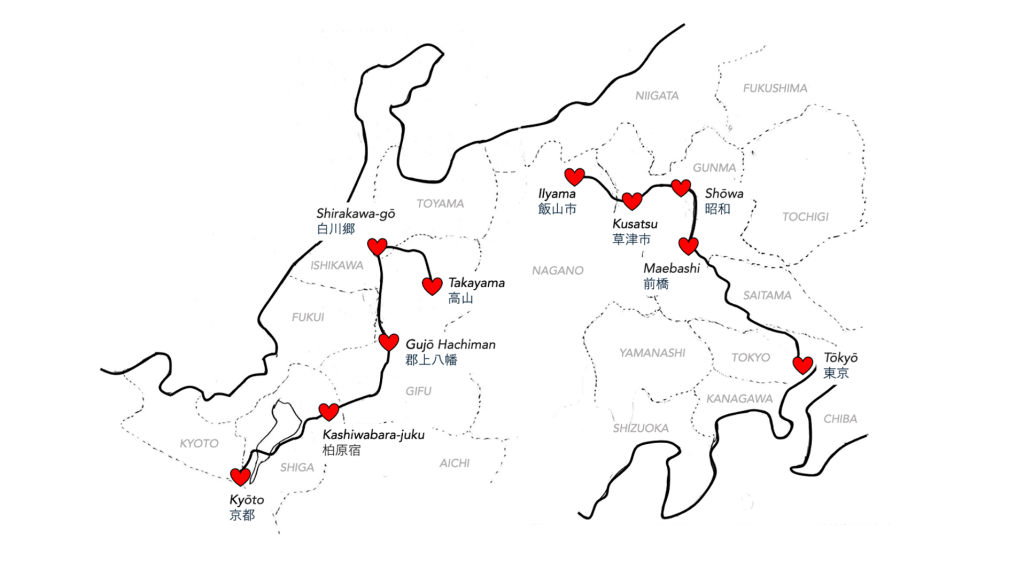
I just rode a tour from Kyoto to Tokyo. In my opinion, it was a very balanced tour. Balance is very important for touring, especially if you plan to ride for a long time. I am still figuring out how to do that, but I think this is an example of a success. I would strongly describe this tour as achievable. It is also corporate America friendly – only 2 of your 3 weeks a year must be taken off at once! You must work forever and ever! MWAHHAHA!
At the end, I have the numbers, achievements and analysis of balance.
1. The Tour
(Play this video as you read, so you can hear some of the things I did)
Japan is blazing during September. 95°F and high humidity basically everyday. I got rained on many times, heavily poured on 4 times. It was typhoon season after all! I also had to split my journey into two legs – I was trying to cross the Kamikochi Skyline the same day as a national holiday, and just could not find a hotel. I managed to find one at the next checkpoint, so I just took a train and moved my schedule up a day, overall a win!
Photo collages by day, along with the highlights!
Day 0: Kyoto: Prepping for the journey with some exploring of Kyoto. I visited temples, kool bike shops, and calm streets. I even managed to get a basket setup from DAISO for ¥900 ($6.05) all in!

Day 1: Kyoto to Kashiwabara: I broke my seatpost bolt at 6am in Kyoto – less than 3 miles into the journey. I was able to hack something together at a nearby hardware store, but ultimately got a new bolt on the other side of the city at a NJS specific bike shop. A whirlwind of a start! Riding out of Kyoto was mostly flat and on some busy roads, but I hit pockets of empty. There were sections that were so loud, not because of cars but because of the insects, that it was hard to hear myself think!

Day 2: Kashiwabara to Gujo-Hachiman: I mostly traversed farms as I exited the Shiga prefecture. There was a small mountain road I took, a taste of what was soon to come. I don’t read Japanese, but the road signs are informative enough from their pictures. The mountain almost looks like a character from MegaMan!

Day 3: Gujo-Hachiman to Shirakwa-go: I left a river town and ended the day in an ancient village. Surrounded on all sides by massive mountains, I can understand how Shirakawa-go must have been an oasis so many years ago (right-most image)!
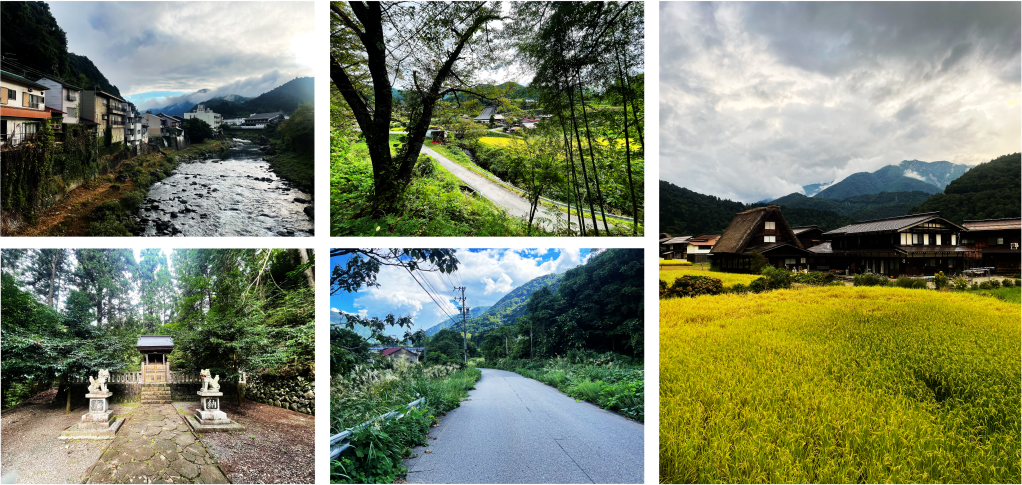
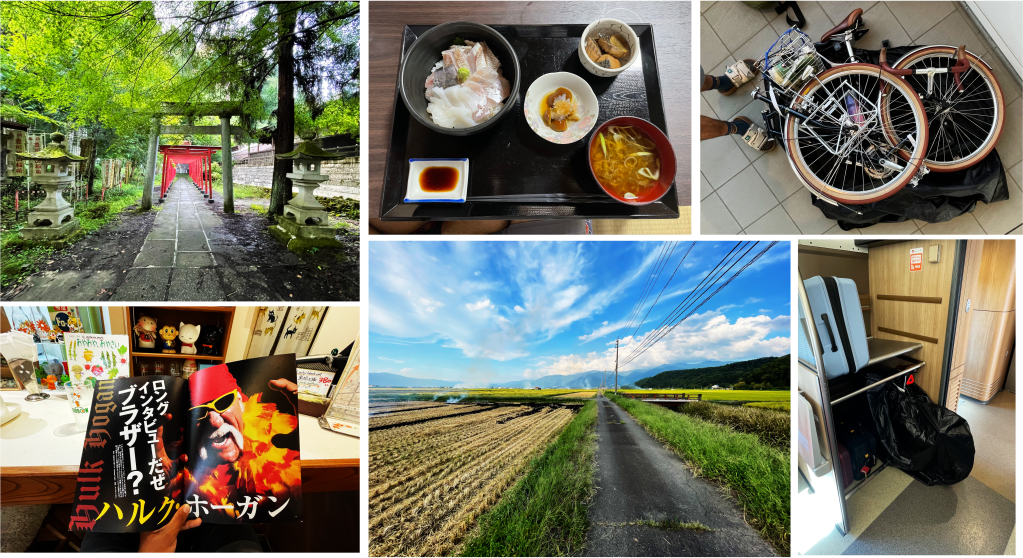
Day 4: Shirakawa-go to Takayama: The start of the Japanese Alps. I took a quiet mountain road out of Shirakawa-go and rode until I hit Takayama. I was super hungry for vegetables at this point (a rare sight in Japanese restaurants) and loved this soup curry place (Soup Curry Tama). The decor was amazing, full of Showa-era character, and the food was even better.

Day 5: Train from Takayama to IIyama: I was supposed to ride over the mountains into Kamikochi, but there were no hotels! I was booking hotels day by day and was looking the same day as a Japanese holiday. I must have called 20 hotels, but got nothing. Luckily the bike I got can be rinko-ed, and I took a train to the next checkpoint. It let me get a day of rest and spend some more time at my start and end cities. This meant another round of Soup Curry in Takayama and watching rice fields burn in IIyama.
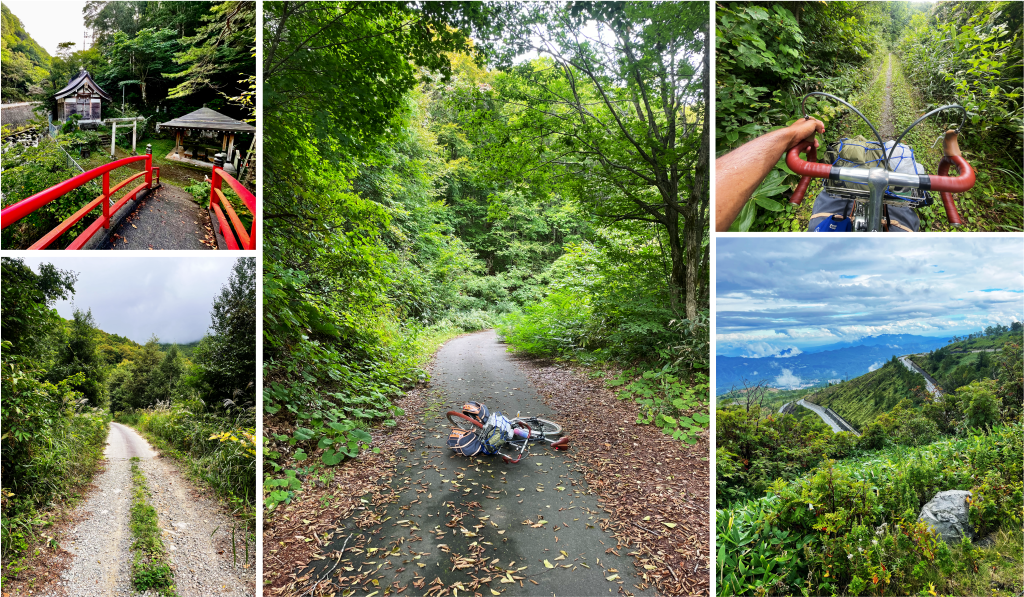
Day 6: IIyama to Kusatsu: The peak of my alps adventure (literally)! Just 2 miles outside of IIyama the climb started, and I didn’t stop until I reached 2200m (7400ft) of elevation in Joshin’etsukogen National Park. I took Rindos (forest roads) the whole way up, with plenty of hike-a-bike when I exceeded the limits of my 42c tires. I then descended in the pouring rain to Kusatsu – famous for its onsens (baths heated by magma water). I passed lots of sizzling magma on my way down (rain instantly vaporized as it hit the magma).
Day 7: Kusatsu to Showa-Village: A good day on the bike, full of quiet roads and beautiful sights, but poorly documented because of how tired I was. The highlight here was actually where I spent the night – Showa-Village, a small farming village in the foothills of Mt. Akagi. I stayed on a family blueberry farm, where I had free reign of the kitchen and cooked myself some vegetables from their garden. All my hosts were fun to connect with, but this one especially so. We talked about the competitive nature of corporate jobs in Japan, the joys of living on less and our favorite animes. Speaking of which…

Day 8: Showa-Village to Maebashi (via Mt. Akagi): Mt. Akagi, home turf of the Akagi Redsuns. You didn’t think I’d visit Gunma and not visit a mountain featured in Initial D? While it wasn’t Mt. Akina, I still found a drainage system on some of the corners that Takami could have used to skirt around a corner faster than those Red Sun scum.

Day 9: Rest in Maebashi: After three climbing days, I needed a break and I stopped in Maebashi. You might think it is just a suburb outside Tokyo, but it punches way above its weight in terms of how interesting it is. There is a whole arts district, complete with a modern art museum, galleries, and interesting shops. I bought merch for the local department store from a local artist here, a super unique piece that I know I would not find anywhere else!

Day 10: Maebashi to Saitama (Omiya Ward, basically Tokyo): The end of the glorious journey. I started on a bike path following the Tone River, but it quickly devolved into sidewalk next to freeway riding. After riding peacefully through the mountains for days, riding into a major metropolis was a reminder that I indeed was in Asia. Thankfully, the traffic quieted when I reached my neighborhood I called home for the next few days, and got to exporting Tokyo as soon as I could!

2. Evaluating Balance
The key metrics for evaluating balance on a tour are:
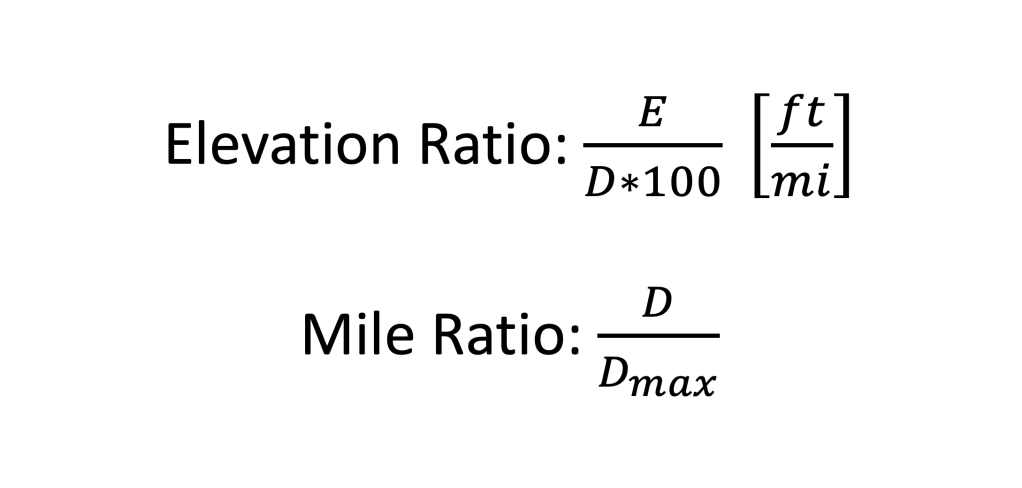
- Elevation Ratio
- Describes how many 100 feet (about one blue whale) of climbing for every mile traveled
- Climbing is the hard part, after all. Contextualizing daily goals is important
- I consider a ratio of 1, especially when carrying luggage, a challenging ride
- Mile Ratio
- Describes how many miles traveled in the day of interest over the longest day of the tour
- When touring under a time crunch, especially when huge mountains are part of your tour, you must munch miles sometimes. The key is to do this when it is flat. Do your best to stop and smell the flowers sometimes.
- Given the longest day was a 75mi, I consider ratio of 1 a challenging ride
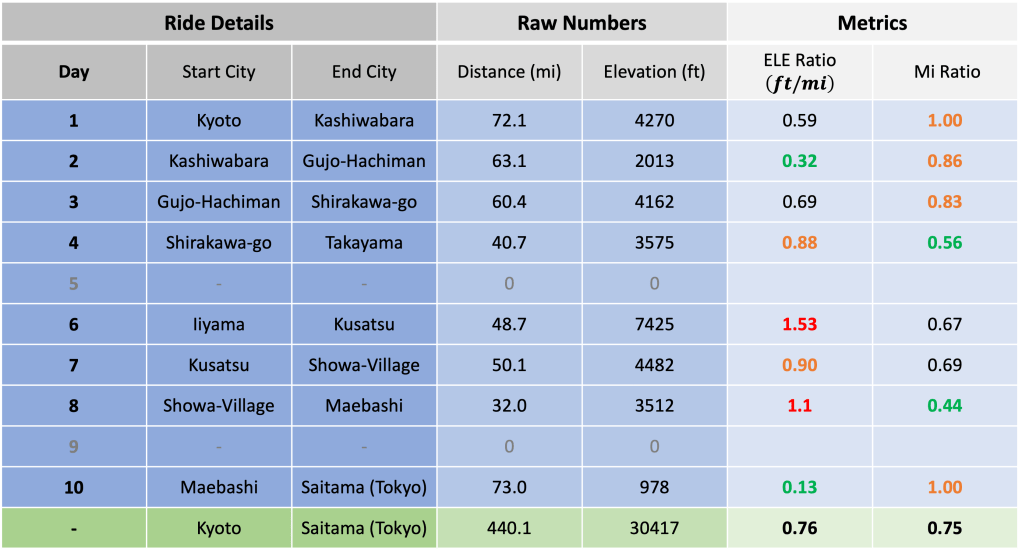
Key equations and data set below:
What were my achievements?
- I saw 440mi (700km) of Japan, all on my bike. Most of that is rural, mountainous and quiet. Full of lush trees, ancient villages, deafaning insects, mountain Buddhist temples and convenience store rice balls
- I summited to the highest point in Japan’s national highway network – 7,200′ (2200m) above sea level
- In total, I climbed 30,500′ (9300m), higher than Mt. Everest at 29,030′ (8850m)
Was this achieved in a balanced way?
Obviously, evaluating if a tour is balanced is subjective. It is determined from your abilities and goals – maybe you would calibrate yourself with a elevation ratio of 1.5 being a challenging ride. With my calibrations as stated above, I would consider this tour as mostly balanced. Some key features are:
- Metrics:
- Looking at the metrics columns, you can see how I ensured a challenging climbing day and a challenging distance day never intersected.
- Tour Day Order:
- My longest, flatest days were at the beginning and end of the tour.
- The hardest climbing days were in the middle of the tour, but paired with low milage and flanked by rest days.
- Overall Metics:
- The overall tour had ratios of ~0.75 for both elevation and distance, just below what I calibrated as being ‘challenging.’
Just below challenging, is balanced in my eyes.
I do have to confess – I didn’t actually plan any of this. I kinda just know what I can ride and after considering both distance and climbing, I just decided my route on the fly. On days I knew were harder, I just started earlier. And when I knew I could take a rest day, I did. Maybe the real point is to just know your limits, and ramble along at the pace you want…
Touring in Japan was incredible, but I can’t wait to get back to touring in California.
I’m coming for you, ‘California Alps’…
 Yelling at the Clouds
Leave a comment